Showing posts with label High Tech. Show all posts

Tuesday, November 10, 2015

Either Side of the Mountain: Utah’s Two County “Tech-Highway”

By Cory Stahle, Regional Economist

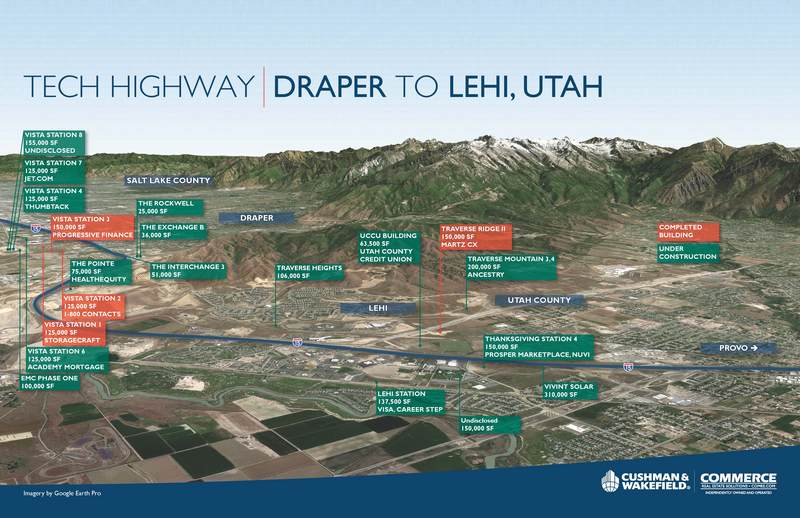
A recently released report from real estate firm Cushman & Wakefield | Commerce, describes a record breaking construction trend occurring around the border of Salt Lake and Utah counties. In the past decade, the entirety of Salt Lake County and northern Utah County (900 plus square miles) have averaged less than one million square feet of new office construction annually. Over the past nine months this annual average has been dwarfed by a five square-mile area along I-15 between Draper and Lehi. With nearly two million square feet of new commercial construction projects underway, primarily in behalf of technology companies, the area is being coined by some as Utah’s “Tech-Highway.” A visual of the growth in construction is illustrated in the following image:

Image Property of: Cushman & Wakefield | Commerce
Construction is a driver and manifestation of the economic growth occurring in the Salt Lake City and Provo metropolitan areas. With a combined job growth rate of 4.2 percent from June 2014 to June 2015, Utah and Salt Lake counties are seeing significant increases in the number of jobs available. A significant portion of these job gains, in line with the Cushman report findings, are occurring in professional/technical service occupations and in construction. In comparing June 2015 to the previous year, nearly 14 percent of total job gains in Utah and Salt Lake counties were in professional/technical fields. Similarly, construction accounted for 10.8 percent of jobs in the two counties during the same period.

Monday, October 6, 2014

Landesk Acquires Naurtech

LANDESK has acquired Naurtech, a company that develops connectivity solutions to provide mobile access to enterprise data and applications using Windows CE platform devices.

Naurtech will be part of the larger LANDESK business, but its product offerings will be maintained separately. LANDESK plans to continue extending Naurtech’s product offerings with additional mobile platform support and leverage Naurtech capabilities in other LANDESK products.  Utah Business

Monday, July 1, 2013

Incentives will mean nearly 740 new jobs for two software firms

A pair of Utah-based software companies will expand their operations in the state, resulting in nearly 740 new jobs over the next few years.

HireVue, based in South Jordan, said it will grow by 540 jobs over seven years, while MasterControl Inc., based in Cottonwood Heights, will expand by 197 jobs over five years.

The companies announced their plans after receiving incentives last week from the Governor’s Office of Economic Development (GOED) board.

HireVue helps customers find, interview, vet and hire employees, using technology that lets companies browse, view, rate and share interviews at their own pace and time, even by using a smartphone. Current customers include Ocean Spray, Nike, Dow Jones and Walmart. Salt Lake Enterprise

Wednesday, June 19, 2013

Salt Lake‐Utah county line a wellspring of economic vitality

In northern Utah County, hundreds of workers at IM Flash Technologies turn the silicon in common sand into speedy, power-efficient flash memory chips that store songs, photos, documents and other data in mobile phones, cameras and tablets.

Just up the road, in Salt Lake County, eBay unwrapped its new 240,000-square-foot Draper campus last month. The buildings accommodate 1,800 people who carry out customer service, software development, human resources and legal and accounting work for the e-commerce giant.

IM Flash and eBay are near Point of the Mountain, the east-west range that separates Salt Lake and Utah counties. It is here where a substantial chunk of Utah’s economic vitality is being created. Salt Lake Tribune

Thursday, June 13, 2013

Amid Data Controversy, NSA Builds Its Biggest Data Farm

As privacy advocates and security experts debate the validity of the National Security Agency's massive data gathering operations, the agency is putting the finishing touches on its biggest data farm yet.

The $1.2 billion complex at a National Guard base 26 miles south of Salt Lake City features 1.5 million square feet of top secret space. High-performance NSA computers alone will fill up 100,000 square feet.

The NSA's Utah Data Center will be able to handle and process five zettabytes of data, according to William Binney, a former NSA technical director. Binney's calculation is an estimate. An NSA spokeswoman says the actual data capacity of the center is classified.

The Utah center will employ about 100 technicians to keep the power and water flowing and the computers and other equipment humming. The NSA and the University of Utah have developed a certificate.

Despite its capacity, the Utah center does not satisfy NSA's data demands. Last month, the agency broke ground on its next data farm at its headquarters at Ft. Meade, Md. But that facility will be only two-thirds the size of the mega-complex in Utah. National Public Radio

Thursday, May 30, 2013

Utah video game makers stay ahead by going mobile

For nearly two decades, Scott Campbell, the CEO of Salt Lake City video game studio Eat Sleep Play, had been designing games for consoles, from the original PlayStation in 1994 to the PlayStation 3 last year. But of late, the industry was clearly in transition — it was moving from the living-room boxes such as Nintendo Wii and Xbox 360, to tiny screens on mobile phones and computer tablets.

Gaming-on-the-go is now king.

Campbell’s company is not the only Utah game studio to change over to mobile game development. Local companies such as Chair Entertainment, Wahoo Studios and EA Salt Lake have all gone from designing games for consoles to creating titles for handhelds. And it’s proving to be a profitable move. Salt Lake Tribune

Tuesday, May 14, 2013

Former Deseret News building transformed into emergency dispatch headquarters

In June, International Academies of Emergency Dispatch purchased the former Deseret News building at 30 E. 100 South in Salt Lake City. In the months since, it has transformed six floors into offices, break rooms and meeting space for 110 of the company's employees. IAED plans to lease remaining space to other businesses.

The company sets protocol, trains dispatchers and develops software for medical, police and fire emergency dispatch systems worldwide. Its rapid growth necessitated expansion from a leased space to the new building, company officials have said. Salt Lake Tribune

Monday, April 22, 2013

L-3 lays off 190 Utah workers

Defense contractor L-3 Communication Systems has laid off about 190 Utah employees, citing downward trends in defense spending and the prospect of short-term cuts due to the budget impasse in Washington.

The layoffs, representing about 4.2 percent of the company’s workforce in Utah, were ``difficult but necessary’’ to maintain the division’s competitiveness and to boost its ability to win and execute new contracts, a company spokeswoman said Thursday.

Workers at L-3’s Salt Lake City site were informed Thursday morning of the job losses, which affected operations, administrative, engineering, technical and professional staff. Salt Lake Tribune

Wednesday, March 6, 2013

Venafi moves software operations to downtown Salt Lake

Venafi, a Sandy-based company that develops software to manage encryption keys, is moving its headquarters to downtown Salt Lake City.

The company signed a seven-year lease to move into a 37,000-square-foot office space inside the City Centre Building at 175 E. 400 South, according to Cushman & Wakefield | Commerce, which negotiated the deal. Salt Lake Tribune

Adobe Summit digital marketing conference opens this week in Salt Lake City

The three-day Adobe Summit 2013, which explores digital marketing, begins today at the Salt Palace Convention Center.

Keynote speakers for the conference include Felix Baumgartner, the man who made the record-setting 24-mile skydiving jump on Oct. 14; Brigham Young University business professor Jeff Dyer; Jack Philbin, CEO of mobile marketing company Vibes; and Marc Jenkins, digital media vice president for NASCAR.

Brad Rencher, Adobe’s general manager of digital marketing, will deliver the conference keynote address at 9 a.m. Wednesday. The talk will be broadcast live on the Internet at the conference website at summit.adobe.com.

Sessions will focus on a range of subjects, from digital marketing and social marketing to marketing tips and Web analytics. Cost for a full conference pass is $2,295. To register go to summit.adobe.com.
Adobe Systems Inc. was co-founded by University of Utah graduate John Warnock and is the maker of creativity and Internet application software. It is the publisher of the popular Adobe Photoshop software, as well as the Acrobat Web-based reader.

In 2009, the San Jose-based company purchased Omniture, a Web analytics company in Lehi, establishing a presence in Utah that now includes a 280,000-square-foot operations building that is home to nearly 1,000 employees. Salt Lake Tribune

Tuesday, March 5, 2013

Utah’s 1st Microsoft store to open April 11 at City Creek

Microsoft announced it is opening its first Utah retail store at the City Creek Center in downtown Salt Lake City.

The store, which will sell Windows-based desktop computers, laptops as well as its Surface tablet, will have a grand opening April 11 at 10:30 a.m. The rock band, Train, which released the hit song, "Drops of Jupiter," will perform after the opening. According to a City Creek newsletter, the band will perform at the Gallivan Center, 239 S. Main St. The gate for the concert will open at noon.

"Microsoft has this really interesting approach to its openings," said City Creek general manager Linda Wardell. "I haven’t seen a retailer do something like this for a store opening in a long time. It’s great for us, and it’s great for them. We’re so excited they are opening their store."

In addition to PC hardware, software, and Windows mobile phones, the Microsoft store also will sell the company’s Xbox 360 video game system and accessories. It also will host training classes for its products as well as be a place for community events.

The Microsoft store will be the 107th business to open at the City Creek Center, which is a combination of retail shops, restaurants, business offices and condominiums. It’s rival, Apple, moved its retail store from the Gateway Mall to City Creek late last year. Salt Lake Tribune

Thursday, February 28, 2013

Building Utah's workforce key to becoming Silicon Valley East

Instead of a place to keep felons behind bars, the ground on which the Utah State Prison now sits could someday be the hub of a sprawling business community where bright minds unlock the door to new technology.

The burgeoning IT corridor in southern Salt Lake County and northern Utah County is poised to be the focal point of Utah's economic future. It's where the state's two largest metropolitan areas converge, both of which have major universities and expanding transportation systems. Companies including Adobe and eBay already call it home.

The governor and state lawmakers convening this week have key roles in preparing the state to take advantage of an anticipated boom, particularly in information technology and life sciences.
And a key component of that is education and building the workforce.

Companies like Goldman Sachs and Procter & Gamble came to Utah primarily because of its business-friendly environment and stellar workforce.

Those two firms account for nearly 2,600 jobs and will pay $437 million in corporate income tax over the next 20 years, all of which goes directly to public education, according to the Governor's Office of Economic Development.

But even though Utah has the second fastest growing economy in the nation, there are signs that the quality of the workforce might not be able to keep up in the technology arena.

Some top economic development officials fear a well-known company might decide against coming to Utah because the state wouldn't be able to supply enough tech-related graduates to fill its needs.
On average, public schools see about 14,000 new students a year, costing an additional $75 million annually.

Bringing a business like Goldman Sachs to Utah each year helps cover those growing education costs. Deseret News

Wednesday, February 20, 2013

Murray council denies request for more Utopia funds

City Council members on Tuesday rejected a request to appropriate $168,800 in additional funding for the financially troubled UTOPIA fiber-optic network.

The money would have been used for operating expenses for UTOPIA (the Utah Telecommunications Open Infrastructure Agency), a consortium of 11 municipalities that is building the high-speed network.

The 4 to 1 vote followed a public hearing in which a dozen speakers opposed giving UTOPIA any more money. Councilman Darren Stam voted to appropriate the money, saying providing the funding would be less expensive in the long run than other options, which include pulling the plug entirely and allowing the project to "go dark."

Opponents at the meeting said enough is enough. Pam Squires described UTOPIA as a "money pit" from the start, while Mike Adams said the agency’s business models aren’t working.

Murray is among the 11 member cities that joined UTOPIA a decade ago; the group committed to $185 million in bond debt that stretches through 2040. The economic downturn, coupled with missteps, led Murray and seven other member cities to form the Utah Infrastructure Agency (UIA) in 2010 to approve an additional $60 million in bonds to rescue the floundering project.

Murray has already paid out $3.6 million for its share and remains on the hook for $58.6 million. The city’s fiber-optic lines are 64 percent built out, and about 22 percent of residents and 10 percent of businesses who could attach to the lines have done so. Only about 10,000 subscribers among all member cities have connected to the network, which has had nine consecutive years of operating losses.

UTOPIA has drawn criticism from Utah lawmakers, who are considering a bill that would make it impossible for the network to use money from the future sale of bonds to fund its day-to-day operations. SB172 would prohibit cities and counties from selling bonds after May 14 to build projects and then use any of that money to operate them more than one year after the debt was issued. Salt Lake Tribune

Thursday, January 31, 2013

SBA launches Affordable Care Act website and blog

The U.S. Small Business Administration has launched a web page and blog to help educate small business owners about the Affordable Care Act.

The new tools will connect the owners of small businesses with information from federal agencies responsible for implementing the law.

"The Affordable Care Act provides small business owners with access and opportunity to provide affordable health care options for their employees," said SBA Administrator Karen G. Mills. "SBA’s new Affordable Care Act web page and blog will serve as resources for small business owners who want learn more about how to take advantage of these benefits."

The Affordable Care Act has many beneficial measures specifically for small businesses; including slowing premium cost growth and increased access to quality, affordable health insurance, according to the SBA.

The new web page, www.sba.gov/healthcare, breaks down the key provisions of the Act based on business size in the following categories: self-employed, fewer than 25 employees, fewer than 50 employees and more than 50 employees.


The web page also provides links to other useful information for small businesses, including a glossary of key health care reform terms, an interactive timeline with dates for when reforms will be implemented, a state-by-state breakdown of health care options and how to learn more about specific tax provisions and regulations.

Additional resources will be added as they become available, the SBA said.

The blog, entitled Health Care Business Pulse (www.sba.gov/blog), will provide small business owners with continuous updates about the implementation of the Act. The blog is for informational purposes only and is not intended as legal or tax advice. Readers should consult their legal or tax professionals to discuss how specific matters relate to their individual business circumstances. Salt Lake Tribune

Salt Lake Community College Held Digital Arts Networking Event for Sundance Film Festival

Salt Lake Community College, in association with the Utah Department of Workforce Services and the Utah Film Commission, held an event that brought digital arts students from around the state to explore job opportunities within the film and digital media industries during the 2013 Sundance Film Festival.

“This event was a great way to capitalize on the excitement that comes to the State during Sundance. It showcased Utah’s many employers in digital arts industries and gave students the opportunity to really get a feel for what occupations in these fields are like,” said Lori Bonham, SLCC Career and Technical Education Marketing Coordinator. “The career job shadow event was a great way to provide students better information they’ll need to make informed decisions about selecting careers in the digital arts industry.”

This event was targeted to Salt Lake Community College digital arts students and to high school students in digital arts programs across the Wasatch Front. SFGate

Wednesday, January 9, 2013

Utah’s Health Catalyst gets $33M in new funding

Utah-based Health Catalyst said Tuesday it had secured $33 million in new investment to help it keep up with growth in the rapidly expanding demand for electronic records for the health care industry.

The company, which has offices in the Cottonwood Heights area of Salt Lake County, said it had received the funding from Norwest Venture Partners and Sequoia Capital, both from the Bay Area, and Sorenson Capital of Utah.

Bullock said Sorenson’s $5 million investment was prompted by Health Catalyst’s position in helping deliver efficient results for health care providers. Health care is the No. 1 economic and humanitarian issue facing the U.S., he said.

"Being able to address that with quality of care and efficiency of care is what [Health Catalyst] does," Bullock said.

Health Catalyst provides software for what it calls a data warehouse, a database that stores information gathered by physicians and others regarding diagnoses and treatments of patients. It then analyzes that information in order to tell providers what works best for patients and what improvements might be made to improve outcomes and make systems more financially efficient.

Burton said the company in the past two years has brought out about 40 programs designed to measure outcomes and costs of specific conditions and diseases, such as diabetes.

Health Catalyst faces stiff competition from some industry database heavyweights such as Oracle and IBM, said Burton. But he said the Utah company’s advantage in the marketplace is that its products were designed specifically for health care providers and were not adopted from other industries. That’s important given the complexity of health care information and its analysis, Burton said.

The company has about 65 employees and is hiring, he said. Salt Lake Tribune

Friday, December 28, 2012

Microsoft Announces 6 New Retail Store Locations

Finally, the news that tens of people have been waiting for: Microsoft is planning to open six new retail stores in 2013 in Texas, Florida, Ohio, California, Utah, and Missouri. The new locations will bring Big Redmond up to 37 full time retail stores in the U.S., with rumors of European expansion in the works, too.

Jonathan Adashek, whose full title is General Manager, Communications and Strategy, Sales & Marketing Services Group, made the announcement in a blog post. Some of these locations will be conversions from popup "Holiday Stores" into full-time retail locations and "Specialty Stores."
The six new store locations:
  • The Shops at La Cantera, San Antonio, Texas
  • Dadeland Mall, Miami, Fla.
  • Beachwood Place, Beachwood, Ohio
  • Westfield San Francisco Centre, San Francisco
  • City Creek Center, Salt Lake City
  • St. Louis Galleria, St. Louis
The company did not announce time frames for the store openings or conversions, but did specify that these are merely the first six store announcements for 2013. The Mac Observer

Related: Microsoft confirms store coming to Utah’s City Creek

Wednesday, December 19, 2012

Three Project Wins, More than 800 New Jobs

Last week EDCUtah, in partnership with the Governor's Office of Economic Development, announced three major project wins that will add 819 new jobs – many of them high-tech – to Utah's economy.

Two of the projects involve homegrown Utah companies: Instructure and Orbit Irrigation Products, Inc. The third project involves The Boeing Company, headquartered in Chicago. Instructure will add 655 jobs to the state, while Orbit will add another 60 jobs. Meanwhile, Boeing will add 104 jobs to its Utah manufacturing operations.

Instructure: EDCUtah President & CEO Jeff Edwards says Instructure plans to expand in the Old Mill Corporate Center at 6330 South and 3000 East, in Cottonwood Heights. The company, which produces learning management software, currently employs 200 Utahns within its software design, R & D, operations, software support and sales operations. This expansion will add 655 more jobs to the state and the company will invest $2.1 million in its new 150,000 square-foot location.

Orbit: Meanwhile, Orbit's decision to build a new manufacturing facility in North Salt Lake will be a boon to Davis County economic development. The facility will employ 60 new people and manufacture pipe, connectors and sprinklers for irrigation systems. The company will make a $37 million capital investment over 15 years.

Boeing: As for Boeing, the company manufactures its 787-8 and -9 Dreamliner vertical fins at its factory near Salt Lake City International Airport and last March announced it would assemble horizontal stabilizers for the 787-9 in Utah as well. Boeing employs 575 Utahns and the new agreement creates the path to grow by another 104 employees immediately. Total head count would be about 679 employees. Utah Pulse

Thursday, December 13, 2012

Utah-based Education Technology Company, Instructure, Announces More Than 600 New Utah Jobs

Utah’s Information Technology and Software industry is thriving, and with the assistance of the Governor’s Office of Economic Development incentive program, Instructure, Inc., announced today that it will expand in Utah.

“The education industry of Utah benefits from keeping companies like Instructure here at home. Education is my number one priority and a cornerstone of our economic development,” Governor Gary Herbert said. “The involvement of key players like Instructure is vital to the highly-skilled and well-educated workforce Utah has the capacity to produce."

Instructure estimates that it will bring 655 potential new jobs to Utah over the seven-year lifetime of the agreement. The average annual wage and benefits of these newly incented positions will be 125 percent of Salt Lake County’s yearly annual wage, including benefits. These wages and benefits will total about $235 million throughout the seven-year agreement with the state.

Instructure’s headquarters are currently located in Sandy, Utah; however, the company plans to expand in Cottonwood Heights.“Instructure is growing faster than we anticipated,” said Josh Coates, CEO of Instructure. “At the close of 2010 we had a handful of employees and almost no revenue to speak of. Today we are closing the year with 200 employees and nearly 300 educational institutions under contract, including all of Utah’s public institutions of higher education.”

To fund the company’s expansion, Instructure will make a $2.1 million capital investment. It will also pay over $9.4 million in new state taxes over the seven-year life of the agreement.

“The GOED Board of Directors has approved a $1,892,969 Economic Development Tax Increment Financing (EDTIF) post-performance refundable tax credit, or 20 percent of the new state revenue paid by Instructure over the seven-year lifetime of the agreement.

Instructure is part of Utah’s Information Technology and Software Development Economic Cluster. Utah’s IT cluster is the largest industry cluster statewide and has been growing in Utah for nearly three decades. The cluster includes over 48,000 companies statewide. Utah Pulse

Thursday, November 29, 2012

How Do Utah's Largest Metro Areas Stack Up in Terms of Economic Competitiveness?

When evaluating the 100 most populous metropolitan statistical areas (MSAs) in the U.S., how do Utah's major metros stack up in terms of economic competitiveness? Very well, in fact.

A report out earlier this month on NewGeography.com says the Provo-Orem, Salt Lake City and Ogden-Clearfield metro areas all rank in the upper third of the top 100 metros in terms of competitiveness. Provo-Orem actually ranks fourth, behind San Jose-Sunnyvale-Santa Clara, CA, Austin-Round Rock-San Marcos, TX, and Bakersfield, CA, while the Salt Lake City metro ranks sixth. Ogden-Clearfield ranks 29th.

Of the Provo-Orem metro, NewGeography says: "This metro area just south of Salt Lake City has seen surprisingly large job gains in professional, scientific, and technical services; administrative and support services; specialty trade contractors; state/local government; and computer and electronic product manufacturing.


NewGeography.com says its goal with the rankings was to see which metros are becoming more competitive (gaining a larger share of total job creation) and which are losing their share of the jobs being created. Hence, all 100 metros were ranked based on the overall competitive effect and what percentage of jobs (from 2010-2012) are based on competitive effects.

To determine the competitiveness rankings, the organization analyzed data from Economic Modeling Specialists Intl (EMSI) using a method called "Shift-share." The analysis focused on overall job change from 2010-2012 in the 100 most populous metropolitan statistical areas (MSAs) in the U.S.

As NewGeography.com explains, Shift-share analysis can also be referred to as "regional competitiveness analysis." It helped the organization distinguish between growth that is primarily based on big national forces (a rising tide lifts all boats) and local competitive advantages. The primary components of NewGeography.com's Shift-share analysis are:

  • Industrial Mix Effect -- Representing the share of regional industry growth explained by the growth of the specific industry at the national level.
  • National Growth Effect -- This explains how much of the regional industry’s growth is explained by the overall growth of the national economy.
  • Expected Change -- This is simply the rate of growth of the particular industry at the national level (equals the sum of the industrial mix and national growth effects).
  • Regional Competitiveness Effect -- This explains how much of the change in a given industry is due to some unique competitive advantage that the region possesses, because the growth cannot be explained by national trends in that industry or the economy as whole.

"To generate our ranking, we summed the overall competitive effect for each broad 2-digit industry sector (e.g., agriculture, manufacturing, health care, construction, etc.) and added them together to yield a single MSA-wide number that indicates the overall competitiveness of the economy as compared to the total economy. We calculate the competitive effect by subtracting the expected jobs (the number of jobs expected for each MSA based on national economic trends) from the total jobs.

"The difference between the total and expected is the competitive effect. If the competitive effect is positive, then the MSA has exceeded expectations and created more jobs than national trends would have suggested. It is therefore gaining a greater share of the total jobs being created. If the competitive effect is
negative, then the MSA is below what we would expect given national trends. In this case the MSA is losing a greater share of the total jobs being created," NewGeography.com explains. Utah Policy