Showing posts with label Construction. Show all posts

Tuesday, November 10, 2015

Either Side of the Mountain: Utah’s Two County “Tech-Highway”

By Cory Stahle, Regional Economist

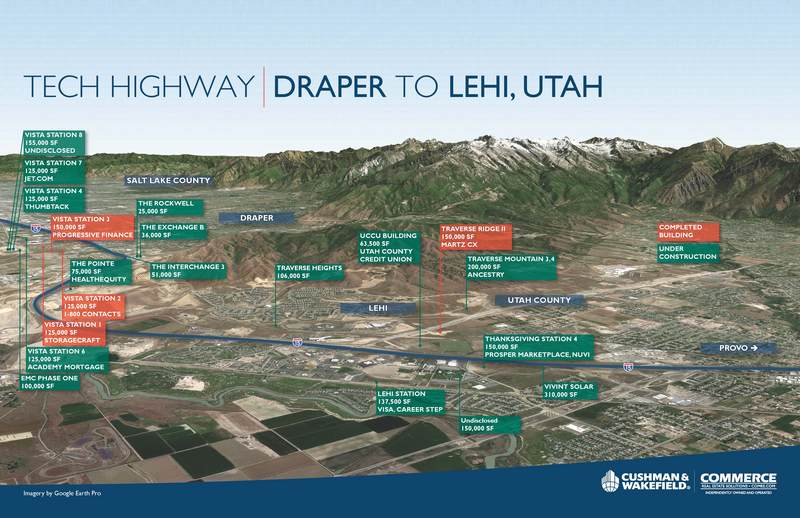
A recently released report from real estate firm Cushman & Wakefield | Commerce, describes a record breaking construction trend occurring around the border of Salt Lake and Utah counties. In the past decade, the entirety of Salt Lake County and northern Utah County (900 plus square miles) have averaged less than one million square feet of new office construction annually. Over the past nine months this annual average has been dwarfed by a five square-mile area along I-15 between Draper and Lehi. With nearly two million square feet of new commercial construction projects underway, primarily in behalf of technology companies, the area is being coined by some as Utah’s “Tech-Highway.” A visual of the growth in construction is illustrated in the following image:

Image Property of: Cushman & Wakefield | Commerce
Construction is a driver and manifestation of the economic growth occurring in the Salt Lake City and Provo metropolitan areas. With a combined job growth rate of 4.2 percent from June 2014 to June 2015, Utah and Salt Lake counties are seeing significant increases in the number of jobs available. A significant portion of these job gains, in line with the Cushman report findings, are occurring in professional/technical service occupations and in construction. In comparing June 2015 to the previous year, nearly 14 percent of total job gains in Utah and Salt Lake counties were in professional/technical fields. Similarly, construction accounted for 10.8 percent of jobs in the two counties during the same period.

Wednesday, April 29, 2015

Wasatch Front South Economic Update

(Salt Lake and Tooele Counties)

Jim Robson, Regional Economist

The Wasatch Front South Service Area labor market ended 2014 with year-over employment growth in December of 2.2 percent. The region’s unemployment rate was a healthy 3.5 percent in the fourth quarter of 2014. Average employment growth in 2014 was 2.4 percent above the level for 2013. There was job growth across all major industrial groups with two exceptions, mining and manufacturing employment. In 2014, the region marked its fourth complete year of economic expansion and labor market improvement since the end of the great recession.

For Salt Lake and Tooele Counties, the continuing healthy job growth and labor market will characterize economic conditions during 2015, with new employment expected to increase about 2.7 percent for the year, an additional 17,700 positions. Total 2015 payroll employment will average about 672,100 jobs in this region. Substantial job increases should come from professional/scientific/technical services, administrative support, trade, financial activities and education.

The improving labor market brought down the unemployment rate to average 3.7 percent in 2014. In the first quarter of 2015 unemployment averaged 3.3 percent and will likely continue to range between 3.0 and 3.4 percent through 2015.

Salt Lake County
* Year-over job increases continue across 15 of 19 industrial sectors with overall nonfarm payroll employment increasing by 2.2 percent from December 2013 to December 2014. The net new jobs from the past year added to the four-plus years of recovery since the employment trough of the recent recession in Salt Lake County.

* Average employment in 2013 was 624320 and 639,395 in 2014, an increase of 15,076 jobs or 2.4 percent. There were 656,221 nonfarm payroll jobs reported by employers in December 2014, which includes the temporary employment surge of the holiday season.

* From December 2013 to December 2014, the most new jobs are being created in professional/scientific/technical services, construction, trade, finance/insurance and food services.

* Within professional/scientific/technical services, 3,265 new job opportunities were concentrated in computer systems design, accounting/bookkeeping, management/technical consulting, architectural and engineering services.

* The 2,279 new construction jobs were spread across commercial, residential, and industrial activities. Residential building permits increased by 16 percent to 6,066, the highest number of permits since 2006.

* Four industries shed jobs from December 2013 to December 2014. Transportation/warehousing declined by 512 positions with most reductions found among truck and air transportation.

* Mining employment was down by about 156 jobs with the effects of declining oil prices being manifest in oil and gas support activities. Manufacturing and information had reductions of 89 and 85 jobs respectively.

* In the fourth quarter of 2014, there was a net increase of 3.5 percent in firms and worksites within Salt Lake County. This increase of 1,381 units brought the total count of firms and worksites to 41,156.

* The seasonally adjusted unemployment rate in Salt Lake County has lessened from 3.9 percent in March 2014 to 3.2 percent in March 2015.  Since March 2014, the number of Salt Lake County residents that are unemployed has declined from about 22,150 to 18,900. Initial claims for unemployment benefits are at their lowest level in five years.

* The stabilization, improvement and expansion in the Salt Lake County labor market since mid-year 2010 have been reflected in the gross taxable sales figures. For 19 consecutive quarters, starting in the second quarter of 2010 and going through the fourth quarter of 2014, Salt Lake County’s year-over change in sales tax collections has been positive. The fourth quarter 2014 year-over taxable sales were up six percent.


Tooele County
* Tooele County’s own job recession continued through the end of 2014 with year-over job losses of 297 for the 12 months ending in December 2014. Payroll employment within the county peaked in mid-2011 and has been down on a year-over comparative basis since then.

* Overall, nonfarm payroll employment totaled 14,870 in December 2014. This is the lowest job count for the month of December since 2005.

* The three largest job reductions from December 2013 to December 2014 occurred in the waste management and remediation services, construction, and the federal government. Many of these losses stem from the direct and indirect effects of the Deseret Chemical Depot closure which was completed by the end of summer of 2014.

* The three industries showing the largest December 2014 year-over employment increases include transportation/warehousing, healthcare/social services, and arts/entertainment/recreation services.

* In 2013, average annual nonfarm payroll Jobs totaled 15,419 in Tooele County. For 2014, there were 14,944 jobs, a reduction of 475 or a decline in payroll positions of 3.1 percent. After accounting for seasonal variations, the level of jobs in the county stabilized in 2014. Therefore, the outlook for 2015 is for the Tooele County job market to return to the plus side of the ledger with some positive overall job additions as year-over employment growth should resume in the spring.

* In the fourth quarter 2014, there was a net increase of 2.4 percent in firms and worksites within Tooele County. This increase of 25 units brought the total count of firms and worksites to 1,056. This increase in payroll firms and worksites is another sign that the economic climate is improving and that new job growth will be returning.

* As part of the greater Salt Lake City Metropolitan Area, Tooele County residents have access to the Salt Lake County job market. Salt Lake’s current relative strength provides support to Tooele County residents.

* The unemployment rate was estimated to be 5 percent in March 2014, improving to a rate of 4 percent in March 2015. There are about 1,170 unemployed Tooele County Residents looking for work in the spring of 2015.

* During the first quarter of 2015, initial unemployment insurance claims averaged the lowest level in Tooele County for any first quarter since 2006. This indicates that the Tooele County labor market has returned to non-recessionary levels of job separations.

* Residential building permits increased by 27.4 percent to 363, the highest number of permits since 2007. The overall value of all permited construction activity increased in 2014 by 16.6 percent over the previous year totaling $142.5 million.

* Gross taxable sales increased by 4.6 percent in the fourth quarter 2014 compared to fourth quarter 2013.

Thursday, October 2, 2014

Construction Begins on Sandy Transit-Oriented Development

Government representatives, employees and other community figures broke ground Tuesday on the East Village, Utah’s first transit-oriented development venture.

The mixed use development got underway with groundbreaking of Phase I of the $42.6 million mixed use development, which includes a 271 unit apartment complex. It will have a density of 50 units per acre with a parking stall ratio of 1.4 stalls per unit. Four additional phases are planned, which will total over 1.4 million square feet of development.

The East Village, in Sandy, is intended to be a model for future development around transit stations that incorporate mixed-use development around major transit infrastructure. Utah Business

Thursday, August 28, 2014

Annual Profiles

The Workforce Research and Analysis division has updated information in the county Annual Profiles.

The information available in these Annual Profiles are separated by county and state and include:
  • quick facts
  • nonfarm employment
  • unemployment
  • major employers
  • population
  • demographics
  • income and wages
  • construction
  • gross taxable sales
  • county rankings
This data is updated on an annual basis, and dates can be found at the bottom of each tab. To print any of the visualizations, see the instructions here. For more information about this data, contact your regional economist.

Tuesday, July 22, 2014

New County Pages

See our new County Pages, each with their own URL for easy bookmarking. Find labor market information that has been divided into counties and regions for a quick look at each area.

Also find a new look for the Current Economic Snapshots (Salt Lake and Tooele). These are economic snapshots are a two-page look at the current information for labor force, sales, building and unemployment insurance for each county in Utah, and are updated monthly after the Employment Situation.

These can be accessed on the Utah Economic Data page or on the Labor Market page under the "County Snapshots" link.

Tuesday, July 2, 2013

Work begins on senior center

Investor Dave Farrell has broken ground on the Cottonwood Place Senior Living Center in Holladay. The new community, located at 5600 S. Highland Dr., is a 127,733 square foot, two-story assisted living and memory care community with an underground parking garage.

Sahara Construction is the design/build contractor and Beecher Walker Architects is the designer of this upscale senior living community.

Farrell is an independent developer of assisted living and memory care communities in California and Utah. Salt Lake Enterprise

Thursday, May 23, 2013

2 hotels to be built in downtown Salt Lake City

Two new hotels in Salt Lake City will be erected south of EnergySolutions Arena, and although they won’t fulfill the need for a convention hotel, they are being touted as a welcome addition to downtown.

The $65 million mixed-use development will include a 159-room extended-stay Hyatt House, a 175-room Courtyard by Marriott, a parking garage and ground-level retail at the intersection of 100 South and 300 West.

Construction on the 100 South hotel complex has begun, and an opening is set for late 2014 or early 2015. Salt Lake Tribune

Thursday, May 16, 2013

Renovation set for revered Little America Coffee Shop

On Monday, Little America Coffee Shop undergoes a six-month renovation and the restaurant will close for remodeling. However, breakfast, lunch and dinner will still be available next door in the steakhouse dining room. The renovation takes place at the same time the first floor of the downtown hotel, 500 South Main, also receives a face-lift. Salt Lake Tribune

Monday, April 29, 2013

Remodeling complete at three Macey’s stores

Macey’s grocery stores in West Jordan, Provo and Pleasant Grove are celebrated a grand reopening, which included new décor, sales and giveaways.

In 1947, Walt Macey and Dale A. Jones started the Save-A-Nickel-Market in Rose Park. Today, Macey’s supermarkets offer a made-from-scratch in-store bakery, delicatessen, full-service grocery, meat, produce and a non-foods department. Salt Lake Tribune

Boyer to build office tower in downtown Salt Lake City

The Boyer Co., one of the most active developers in Salt Lake City, has started construction of a seven-story office building on the east side of the central business district.

The building, to be called 101 Tower, is being built on an empty lot at the southeast corner of 100 South and 200 East. It will be across the street from the former Questar building on 100 South, which Boyer bought in January. Questar, which also owned the lot, moved to a new headquarters a few blocks away. Salt Lake Tribune

Friday, March 22, 2013

West Valley Breaks Ground on Residential Building

Crews have broken ground on the first new residential building located at Fairbourne Station in West Valley City, a mixed-use redevelopment at the city’s center. Construction of the residential building is the latest milestone in the city’s revitalization project.

The 225-unit apartment building will be constructed at 2900 West Lehman Avenue between The Promenade, a six-acre park that opened August 2012, and the new Embassy Suites hotel, which opened last January. It is also steps away from an intermodal transit station that offers light rail, bus rapid transit and traditional bus service.

The Residences at Fairbourne Station are being developed by ICO development, an Ivory Homes Company. Construction is expected to be complete in fall of 2014, and additional residences are planned for future development. Utah Business

Tuesday, March 19, 2013

Salt Lake City’s Gateway launches $2 million renovation

Although adding new stores to fill empty storefronts doesn’t appear imminent, The Gateway is endeavoring to remake itself, starting with a $2 million renovation at the downtown Salt Lake City mall.

This comes as the one-year anniversary approaches for the opening of neighboring City Creek Center, which over the past 12 months has landed more than a dozen high-profile retail tenants that used to call The Gateway home.

The renovation project is focusing on ambiance and on the 12-year-old Gateway becoming more of a community gathering spot, said General Manager Scott Bennett.

By early summer, shoppers will see more shaded seating areas, surrounded by flowering plants. More than 220 seats will be added to nearly 150 existing spots designed to allow shoppers to rest and relax. In colder months, the areas will be warmed by fire pits. Salt Lake Tribune

Wednesday, March 13, 2013

Utah’s first Dunkin’ Donuts to open in Salt Lake in June

Sizzling Platter, a Utah-based restaurant management company plans to open the first of 16 Utah Dunkin’ Donuts locations in Salt Lake City at 200 E. 400 South in June.

Sizzling Platter is renovating a former Burger King, across from the Salt Lake City Public Library.

Sizzling Platter operates Dunkin’ Donuts locations in Texas and manages restaurant locations across seven western states under the Dunkin’ Donuts, Little Caesars, Sizzler, Red Robin and Hoppers Grill & Brewery brands. Salt Lake Tribune

Thursday, February 28, 2013

Building Utah's workforce key to becoming Silicon Valley East

Instead of a place to keep felons behind bars, the ground on which the Utah State Prison now sits could someday be the hub of a sprawling business community where bright minds unlock the door to new technology.

The burgeoning IT corridor in southern Salt Lake County and northern Utah County is poised to be the focal point of Utah's economic future. It's where the state's two largest metropolitan areas converge, both of which have major universities and expanding transportation systems. Companies including Adobe and eBay already call it home.

The governor and state lawmakers convening this week have key roles in preparing the state to take advantage of an anticipated boom, particularly in information technology and life sciences.
And a key component of that is education and building the workforce.

Companies like Goldman Sachs and Procter & Gamble came to Utah primarily because of its business-friendly environment and stellar workforce.

Those two firms account for nearly 2,600 jobs and will pay $437 million in corporate income tax over the next 20 years, all of which goes directly to public education, according to the Governor's Office of Economic Development.

But even though Utah has the second fastest growing economy in the nation, there are signs that the quality of the workforce might not be able to keep up in the technology arena.

Some top economic development officials fear a well-known company might decide against coming to Utah because the state wouldn't be able to supply enough tech-related graduates to fill its needs.
On average, public schools see about 14,000 new students a year, costing an additional $75 million annually.

Bringing a business like Goldman Sachs to Utah each year helps cover those growing education costs. Deseret News

Wednesday, February 27, 2013

Hale Centre Theatre moving to Sandy

It’s official: Hale Centre Theatre will have a new home in Sandy by 2017.

Theater co-founders Mark and Sally Dietlein announced Monday they had come to an agreement with Sandy to build an upgraded facility on 11.5 acres close to 10000 South and I-15. Sandy sold the site to Hale Centre Theatre for $7.5 million at the same price the city originally purchased it.

At its current West Valley City location, the theater receives about 255,000 unique visitors annually. It has been operating at more than 100 percent capacity for the past two years.

West Valley City officials ended negotiations to keep the theater in the city earlier this month, saying they had made every accommodation possible and were doubtful theater owners wanted to stay and expand there.

Hale Centre Theatre approached Sandy almost two years ago to gauge the city's interest in having the theater there. The main obstacle in negotiations was finding a piece of property large and visible enough until Sandy bought the land in December.

The new theater will include three separate stages. The Centre Stage Theatre will have a capacity of 800 seats, the Proscenium will hold 700, and the black box theater will seat 300. The facility will also include spaces for receptions and business meetings, as well as expanded set design shops and costume rooms.

According to theater spokesman Chris Thomas, the expansion will cost about $65 million to complete.

The current West Valley City facility has one stage and 613 seats. The new main theater in Sandy will be slightly larger than the current theater with an additional row and improved legroom.

But it was more than just facility size that prompted the theater to make the move. Brough said the visible location ultimately led the board of directors to finalize a difficult decision. Deseret News

Sugarhouse BBQ to move as streetcar project rolls along

The SugarHouse Barbecue Company, a mainstay in Salt Lake City for 17 years, is moving to make way for the return of streetcars.

In April, the restaurant will move two blocks east, from 2207 S. 700 East to the new location at 880 E. 2100 South.

Owner Bill Smithers is remodeling the building at the new location, which should be done sometime in the early spring. Diners, hopefully, will not go more than a week between the old building closing and the new location’s opening.

The restaurant specializes in Memphis-style barbecue, featuring a process called dry rub. A blend of spices is rubbed into the meat, which is then slow smoked for several hours. Diners have a choice of four different sauces and a variety of side dishes.

For years, it hasn’t been easy to drive into the restaurant, particularly for motorists traveling southbound on 700 East. Entering the property will become even more difficult with the new streetcars. In addition, the restaurant will be losing as many as 30 parking stalls, which are currently being leased for its customers.


Construction on the streetcar network began last May. Riders should be able to use the new streetcar system, complete with seven stations, by the end of 2013.

The streetcars will run along a new two-mile stretch of rail that will connect South Salt Lake’s old warehouse district near the Central Pointe TRAX light rail station to the thriving commercial hub in the Sugar House neighborhood.

The $37.2 million Sugar House project is funded from a $26 million federal Transportation Investment Generating Economic Recovery grant and $11.2 million from South Salt Lake, Salt Lake City and Utah Transit Authority funds.

UTA expects the project to generate 700 short-term construction jobs and to add 7,500 new jobs to the local economy by 2030. It also could generate over $1 billion in new business development along the line.

In the early 1900s the Salt Lake Valley hosted a thriving electric streetcar network. But the trolleys made their last runs by 1946, giving way to bus and automobile travel. Today, streetcars are seeing resurgence,

partly due to fuel prices and environmental concerns, and are revitalizing urban neighborhoods around the nation. Salt Lake Tribune

Wednesday, February 20, 2013

Utah Senate committee debates prison relocation

Utah lawmakers are considering a plan to relocate the state prison in southwest Salt Lake County.

Sen. Scott Jenkins introduced legislation that creates an authority to manage the relocation of the Utah State Prison and evaluate proposals from companies seeking to build a new prison or develop the old site.

The Utah State Prison occupies about 700 acres in Draper where tech companies such as eBay and Microsoft have opened offices.

Gov. Gary Herbert has called on lawmakers to fund the relocation so the corridor can develop as a technology hub. State officials have been weighing relocation for several years.

The Utah State Prison was built in 1951 and houses about 4,500 inmates. Before that, Utah's state prison was at what is now Sugar House Park.

The state also operates a prison in Gunnison, the Central Utah Correctional Facility.

The goal is to get the legislation passed quickly so the authority can get up and running by April 15, as required by the bill, Sen. Scott Jenkins said.

The authority would then seek proposals from companies and come back to the Legislature and governor with a viable option.

It's unlikely any proposal would be ready to come before the Legislature by the time next year's session concludes, but the governor could convene lawmakers in a special session to approve the plan.

Some of the possible sites that have been considered for the new prison are in northwest Utah _ specifically Box Elder County, Juab County and Tooele County. Cache Valley Daily

Tuesday, February 12, 2013

Utah utility shines light on renewable-energy projects with funding

As soon as spring weather arrives, developers of the Artspace Solar Gardens property near downtown Salt Lake City plan to install a 315-kilowatt solar power array on its roof and parking garage.

The project, funded in part through Rocky Mountain Power’s Blue Sky program, will feature nearly 1,000 solar panels that are expected to generate enough electricity to meet all the power needs of the 30 residential and 15 commercial office units in the mixed-use development, with maybe a little left over.

Without $320,000 in Blue Sky funding, developers would have had enough money to build a system only half the size, said Jessica Norie, executive director of Artspace. Artspace operates five mixed-use properties in and around downtown Salt Lake City, including the Solar Gardens under construction at 400 W. 850 South.

The Solar Gardens system is one of 20 projects the electrical utility is funding this year, to the tune of a combined $1.8 million.

Since 2006, Rocky Mountain Power has supported more than 80 community-based, renewable-energy projects, said utility spokesman Jeff Hymas.

The utility’s president and CEO Richard Walje said the awards will enable funded groups to use a renewable resource to generate electricity and save money on their energy bills and reduce their environmental footprint while promoting awareness of renewable energy and how it works.

Although this year all the funding went to solar energy systems, initiatives that support production of wind, biomass, landfill gas, low-impact hydro- and geothermal energy also are eligible. Salt Lake Tribune

Friday, February 1, 2013

Cottonwood Mall plans are alive, barely, as nearby stores languish

In May 2008, retail developer General Growth Properties held a groundbreaking ceremony to launch the building of a sprawling new shopping center, office space and condominiums where the old Cottonwood Mall once stood in Holladay.

Nearly five years later, there still is no new massive 54-acre development —just a 54-acre crater of weeds, brush and now snow that cover what in the early 1960s was the state’s first indoor shopping center.

With foot traffic down in their stores and frustration building by the day, merchants big and small in shops that surround the long-stalled project have been waiting for any sign of movement. As another new year dawns, there’s still nothing concrete just yet, but Holladay city officials say they’re heartened by recent signals from the developer that things are finally moving forward, if only slowly.

Amid all the disappointment, Holladay City Manager Randy Fitts is hopeful that another five years won’t go by before merchants, residents and others see progress made on the $550 million project, whose mixed-use features of retail shops, office space and condos would make it similar to The Gateway or the City Creek development in downtown Salt Lake City. The proposal calls for 617,000 square feet of stores, 226,000 square feet of office space and 614 residential units. Salt Lake Tribune

Wednesday, January 16, 2013

Salt Lake County moves funding along for theater renovation

Renovations at the Capitol Theatre must be done in time for pre-Christmas performances of The Nutcracker.

So the Salt Lake County Council moved Tuesday to keep the project on its tight timetable, releasing $3 million to begin phase one of a $33.4 million public/private endeavor to give the century-old theater a face-lift and to erect a new Ballet West dance academy building adjacent to it.

Starting in June, demolition crews will begin punching holes in walls, tearing out the stage and orchestra pit, removing 1,819 well-worn seats and stripping the lobby down to the frame.

Ballet West was responsible for raising $13.5 million for the project, which includes development of the Jessie Eccles Quinney Center for Dance. The five-story structure will be home to the ballet and an academy with up to 600 dance students. Salt Lake Tribune