A new book released yesterday shows that between 2000 and 2011, the rise in suburban poverty rose 64 percent, more than twice the growth rate of poverty in cities.
By 2011, almost 16.4 million suburban residents nationwide lived below the federal poverty level — now surpassing the number of impoverished city dwellers by 3 million, according to Confronting Suburban Poverty in America, written by Elizabeth Kneebone and Alan Berube of the Brookings Institution Metropolitan Program.
Surprisingly, the suburban areas of three Utah cities ranked among the book’s top 15 in terms of fastest-growing poverty: Salt Lake City came in third with a 142 percent jump, the Provo-Orem area ranked eighth with a 129 percent increase and Ogden-Clearfield came in 14th with a bump of 105 percent.
Berube and Kneebone see this rapid growth in suburban poverty as more than a temporary change caused by the recent recession. They attribute the rise to shifts in jobs and wages, population growth and immigration, collapse of the housing market and the foreclosure crisis. Salt Lake Tribune
Showing posts with label Region--Wasatch Front North. Show all posts
Showing posts with label Region--Wasatch Front North. Show all posts
Tuesday, May 21, 2013
Friday, April 19, 2013
Halting urban sprawl may improve social interaction
Wasatch Front leaders who seek to halt urban sprawl and instead develop new town centers around transit hubs might do more than just reduce traffic congestion and pollution — they may also make social interaction much easier, fueling more innovation and creativity locally.
That’s according to a Steven Farber, a University of Utah geography professor who just published, along with Xiao Li, research in the Journal of Transport Geography about how social interaction is affected by sprawl or centralization.
The consortium envisions that many people would live in buildings that have businesses on the first floor, offices on the second and residences above that. Town centers would be designed to allow people to live, work and play in the same area so they would commute less. Salt Lake Tribune
That’s according to a Steven Farber, a University of Utah geography professor who just published, along with Xiao Li, research in the Journal of Transport Geography about how social interaction is affected by sprawl or centralization.
The consortium envisions that many people would live in buildings that have businesses on the first floor, offices on the second and residences above that. Town centers would be designed to allow people to live, work and play in the same area so they would commute less. Salt Lake Tribune


Thursday, February 28, 2013
Even as home prices, sales rise, Wasatch Front listings at 15-year low
The number of homes along the Wasatch Front listed for sale was at a 15-year low at the end of 2012, even as prices rose steadily through most of the year and sales gained ground.
The scarcity of homes on the market underlines the severity of the housing market’s collapse in Weber, Davis, Salt Lake and Utah counties, as well as many Utahns’ uncertainty about the pace of the recovery, real estate experts say.
Listings peaked in the fourth quarter of 2007 at 14,683 homes, according to the Salt Lake Board of Realtors, which cited figures compiled by the Wasatch Front Regional Multiple Listing Service. By the end of last year, that number, which includes foreclosures and short sales, had been cut to 7,229 — the lowest count since the fourth quarter of 1997, when 5,767 homes were on the market.
Myriad reasons are offered why sellers are holding back, even as demand for homes rises. Some say the 6 percent gain in the median price of a single-family home in Salt Lake County last year wasn’t enough to offset the sharpest decline in values since World War II.
"Prices dropped by 25 percent in Salt Lake County. So a [6 percent increase] is good news. But it’s not enough to motivate me to put my house on the market right now," said Jim Wood, director of the University of Utah’s Bureau of Economic and Business Research.
The economist owns a pair of homes and wants to sell one. Because he expects prices to rise 10 percent to 12 percent this year, he will wait awhile before listing it with an agent.
Like other experts, Wood believes the number of listings probably won’t fall further in 2013. Still, many potential sellers are more likely than not to stay on the sidelines until values rise further, he said.
Home sales in Salt Lake County jumped 15 percent last year, to 10,870 units from 9,452 in 2011. The gain was on top of a double-digit rise over 2010. Dave Frederickson, president of the Board of of Realtors, said worries that record low interest rates might rise soon is driving many buyers to snap up properties on the market — so much so that bidding wars have erupted over well-priced homes. And that’s pulled the inventory well under numbers that were typical before the housing bubble formed, he said.
"Interest rates have almost caused a feeding frenzy. It’s not allowing us to build back up supply. I don’t know if a lot of potential sellers out there even know [the housing market] has come back," Frederickson said. "The buyers are catching on to that quicker than the sellers are." Salt Lake Tribune
The scarcity of homes on the market underlines the severity of the housing market’s collapse in Weber, Davis, Salt Lake and Utah counties, as well as many Utahns’ uncertainty about the pace of the recovery, real estate experts say.
Listings peaked in the fourth quarter of 2007 at 14,683 homes, according to the Salt Lake Board of Realtors, which cited figures compiled by the Wasatch Front Regional Multiple Listing Service. By the end of last year, that number, which includes foreclosures and short sales, had been cut to 7,229 — the lowest count since the fourth quarter of 1997, when 5,767 homes were on the market.
Myriad reasons are offered why sellers are holding back, even as demand for homes rises. Some say the 6 percent gain in the median price of a single-family home in Salt Lake County last year wasn’t enough to offset the sharpest decline in values since World War II.
"Prices dropped by 25 percent in Salt Lake County. So a [6 percent increase] is good news. But it’s not enough to motivate me to put my house on the market right now," said Jim Wood, director of the University of Utah’s Bureau of Economic and Business Research.
The economist owns a pair of homes and wants to sell one. Because he expects prices to rise 10 percent to 12 percent this year, he will wait awhile before listing it with an agent.
Like other experts, Wood believes the number of listings probably won’t fall further in 2013. Still, many potential sellers are more likely than not to stay on the sidelines until values rise further, he said.
Home sales in Salt Lake County jumped 15 percent last year, to 10,870 units from 9,452 in 2011. The gain was on top of a double-digit rise over 2010. Dave Frederickson, president of the Board of of Realtors, said worries that record low interest rates might rise soon is driving many buyers to snap up properties on the market — so much so that bidding wars have erupted over well-priced homes. And that’s pulled the inventory well under numbers that were typical before the housing bubble formed, he said.
"Interest rates have almost caused a feeding frenzy. It’s not allowing us to build back up supply. I don’t know if a lot of potential sellers out there even know [the housing market] has come back," Frederickson said. "The buyers are catching on to that quicker than the sellers are." Salt Lake Tribune
Monday, February 25, 2013
2011 Advance GDP by Metropolitan Area Released
The U.S. Bureau of Economic Analysis recently released gross domestic product estimates for the nation’s 366 metropolitan areas. In 2011, metropolitan area growth registered an average of 1.6 percent—just slightly higher than the U.S. total (1.5 percent). However, the growth rate for metro areas dropped noticeably from the 2010 expansion of 3.1 percent.
Only 242 of the nation’s metropolitan areas experienced a 2011 gain in GDP. However, all of Utah’s metro area’s showed increases equal to or greater than the U.S. metro average. Both Ogden/Clearfield and Provo/Orem generated gains of greater than 5 percent. Lowest on the scale proved the Logan metro area with a gain of only 1.6 percent. For more information on the current release, click here.
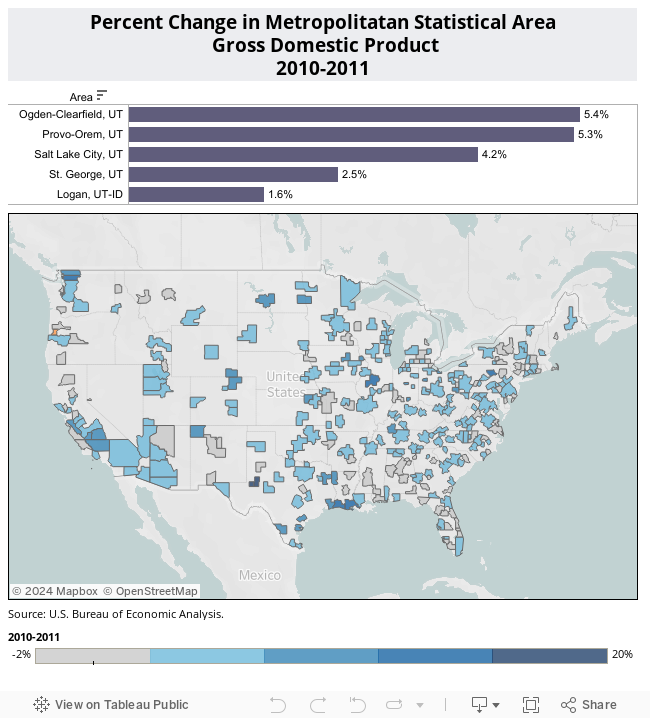
Only 242 of the nation’s metropolitan areas experienced a 2011 gain in GDP. However, all of Utah’s metro area’s showed increases equal to or greater than the U.S. metro average. Both Ogden/Clearfield and Provo/Orem generated gains of greater than 5 percent. Lowest on the scale proved the Logan metro area with a gain of only 1.6 percent. For more information on the current release, click here.
Thursday, February 14, 2013
Even as home prices, sales rise, Wasatch Front listings at 15-year low
The number of homes along the Wasatch Front listed for sale was at a 15-year low at the end of 2012, even as prices rose steadily through most of the year and sales gained ground.
The scarcity of homes on the market underlines the severity of the housing market’s collapse in Weber, Davis, Salt Lake and Utah counties, as well as many Utahns’ uncertainty about the pace of the recovery, real estate experts say.

Listings peaked in the fourth quarter of 2007 at 14,683 homes, according to the Salt Lake Board of Realtors, which cited figures compiled by the Wasatch Front Regional Multiple Listing Service. By the end of last year, that number had been cut to 7,229 —the lowest count since the fourth quarter of 1997, when 5,767 homes were on the market.
Myriad reasons are offered why sellers are holding back, even as demand for homes rises. Some say the 6 percent gain in the median price of a single-family home in Salt Lake County last year wasn’t enough to offset the sharpest decline in values since World War II.
"Prices dropped by 25 percent in Salt Lake County. So a [6 percent increase] is good news. But it’s not enough to motivate me to put my house on the market right now," said Jim Wood, director of the University of Utah’s Bureau of Economic and Business Research.
Like other experts, Wood believes the number of listings probably won’t fall further in 2013. Still, many potential sellers are more likely than not to stay on the sidelines until values rise further, he said.
Home sales in Salt Lake County jumped 15 percent last year, to 10,870 units from 9,452 in 2011. The gain was on top of a double-digit rise over 2010. Dave Frederickson, president of the Board of of Realtors, said worries that record low interest rates might rise soon is driving many buyers to snap up properties on the market —so much so that bidding wars have erupted over well-priced homes. And that’s pulled the inventory well under numbers that were typical before the housing bubble formed, he said.
"Interest rates have almost caused a feeding frenzy. It’s not allowing us to build back up supply. I don’t know if a lot of potential sellers out there even know [the housing market] has come back," Frederickson said. "The buyers are catching on to that quicker than the sellers are."
Realtor Adam Kirkham thinks that with prices down 25 percent since 2007, a lot of would-be sellers who bought homes at the height of the market may not have enough equity to sell them at an acceptable profit. Worse, some people might even be upside-down in their mortgages — owing more than their homes are worth. So they won’t —or can’t — put their homes up for sale, he said. Salt Lake Tribune
The scarcity of homes on the market underlines the severity of the housing market’s collapse in Weber, Davis, Salt Lake and Utah counties, as well as many Utahns’ uncertainty about the pace of the recovery, real estate experts say.

Listings peaked in the fourth quarter of 2007 at 14,683 homes, according to the Salt Lake Board of Realtors, which cited figures compiled by the Wasatch Front Regional Multiple Listing Service. By the end of last year, that number had been cut to 7,229 —the lowest count since the fourth quarter of 1997, when 5,767 homes were on the market.
Myriad reasons are offered why sellers are holding back, even as demand for homes rises. Some say the 6 percent gain in the median price of a single-family home in Salt Lake County last year wasn’t enough to offset the sharpest decline in values since World War II.
"Prices dropped by 25 percent in Salt Lake County. So a [6 percent increase] is good news. But it’s not enough to motivate me to put my house on the market right now," said Jim Wood, director of the University of Utah’s Bureau of Economic and Business Research.
Like other experts, Wood believes the number of listings probably won’t fall further in 2013. Still, many potential sellers are more likely than not to stay on the sidelines until values rise further, he said.
Home sales in Salt Lake County jumped 15 percent last year, to 10,870 units from 9,452 in 2011. The gain was on top of a double-digit rise over 2010. Dave Frederickson, president of the Board of of Realtors, said worries that record low interest rates might rise soon is driving many buyers to snap up properties on the market —so much so that bidding wars have erupted over well-priced homes. And that’s pulled the inventory well under numbers that were typical before the housing bubble formed, he said.
"Interest rates have almost caused a feeding frenzy. It’s not allowing us to build back up supply. I don’t know if a lot of potential sellers out there even know [the housing market] has come back," Frederickson said. "The buyers are catching on to that quicker than the sellers are."
Realtor Adam Kirkham thinks that with prices down 25 percent since 2007, a lot of would-be sellers who bought homes at the height of the market may not have enough equity to sell them at an acceptable profit. Worse, some people might even be upside-down in their mortgages — owing more than their homes are worth. So they won’t —or can’t — put their homes up for sale, he said. Salt Lake Tribune
Thursday, January 31, 2013
Olene Walker Housing Loan Fund Board Approves Funding for 497 Affordable Housing Units in Utah
The Olene Walker Housing Loan Fund Board approved $6,933,092 in low interest loans for housing projects throughout the state of Utah during a funding meeting held here on January 24.
Salt Lake County will be home to many of the approved projects, other projects will be constructed in Grand and Weber Counties. Department of Workforce Services
Salt Lake County will be home to many of the approved projects, other projects will be constructed in Grand and Weber Counties. Department of Workforce Services
Wednesday, January 16, 2013
Fuel Your School Program Benefits Nearly 700,000 Students in Nine Communities across the U.S.
Chevron U.S.A. Inc. and DonorsChoose.org today announced that its Fuel Your School program funded $4.49 million, benefiting local classroom projects at 1,733 K-12 public schools across the country and impacting a total of 697,904 students in 2012.
Through Chevron's Fuel Your School program, 5,673 teachers in nine markets received critical classroom resources.
Through the Fuel Your School program, Chevron contributed $1 for purchases of eight or more gallons, up to a total contribution of nearly $5 million, between Oct. 1 and Oct. 31 at participating Chevron and Texaco stations in nine U.S. markets, including Salt Lake and Davis counties. In total, $4.49 million dollars were generated to benefit [nationwide] public school classroom projects posted on DonorsChoose.org.
The purpose of the Fuel Your School program is to help support and improve critical education programming and materials, particularly in the STEM subjects - science, technology, engineering and math - to help prepare students for the growing number of technical jobs in the modern economy, including possible engineering positions at Chevron. Market Watch
Through Chevron's Fuel Your School program, 5,673 teachers in nine markets received critical classroom resources.
Through the Fuel Your School program, Chevron contributed $1 for purchases of eight or more gallons, up to a total contribution of nearly $5 million, between Oct. 1 and Oct. 31 at participating Chevron and Texaco stations in nine U.S. markets, including Salt Lake and Davis counties. In total, $4.49 million dollars were generated to benefit [nationwide] public school classroom projects posted on DonorsChoose.org.
The purpose of the Fuel Your School program is to help support and improve critical education programming and materials, particularly in the STEM subjects - science, technology, engineering and math - to help prepare students for the growing number of technical jobs in the modern economy, including possible engineering positions at Chevron. Market Watch
Wednesday, December 19, 2012
Three Project Wins, More than 800 New Jobs
Last week EDCUtah, in partnership with the Governor's Office of Economic Development, announced three major project wins that will add 819 new jobs – many of them high-tech – to Utah's economy.
Two of the projects involve homegrown Utah companies: Instructure and Orbit Irrigation Products, Inc. The third project involves The Boeing Company, headquartered in Chicago. Instructure will add 655 jobs to the state, while Orbit will add another 60 jobs. Meanwhile, Boeing will add 104 jobs to its Utah manufacturing operations.
Instructure: EDCUtah President & CEO Jeff Edwards says Instructure plans to expand in the Old Mill Corporate Center at 6330 South and 3000 East, in Cottonwood Heights. The company, which produces learning management software, currently employs 200 Utahns within its software design, R & D, operations, software support and sales operations. This expansion will add 655 more jobs to the state and the company will invest $2.1 million in its new 150,000 square-foot location.
Orbit: Meanwhile, Orbit's decision to build a new manufacturing facility in North Salt Lake will be a boon to Davis County economic development. The facility will employ 60 new people and manufacture pipe, connectors and sprinklers for irrigation systems. The company will make a $37 million capital investment over 15 years.
Boeing: As for Boeing, the company manufactures its 787-8 and -9 Dreamliner vertical fins at its factory near Salt Lake City International Airport and last March announced it would assemble horizontal stabilizers for the 787-9 in Utah as well. Boeing employs 575 Utahns and the new agreement creates the path to grow by another 104 employees immediately. Total head count would be about 679 employees. Utah Pulse
Two of the projects involve homegrown Utah companies: Instructure and Orbit Irrigation Products, Inc. The third project involves The Boeing Company, headquartered in Chicago. Instructure will add 655 jobs to the state, while Orbit will add another 60 jobs. Meanwhile, Boeing will add 104 jobs to its Utah manufacturing operations.
Instructure: EDCUtah President & CEO Jeff Edwards says Instructure plans to expand in the Old Mill Corporate Center at 6330 South and 3000 East, in Cottonwood Heights. The company, which produces learning management software, currently employs 200 Utahns within its software design, R & D, operations, software support and sales operations. This expansion will add 655 more jobs to the state and the company will invest $2.1 million in its new 150,000 square-foot location.
Orbit: Meanwhile, Orbit's decision to build a new manufacturing facility in North Salt Lake will be a boon to Davis County economic development. The facility will employ 60 new people and manufacture pipe, connectors and sprinklers for irrigation systems. The company will make a $37 million capital investment over 15 years.
Boeing: As for Boeing, the company manufactures its 787-8 and -9 Dreamliner vertical fins at its factory near Salt Lake City International Airport and last March announced it would assemble horizontal stabilizers for the 787-9 in Utah as well. Boeing employs 575 Utahns and the new agreement creates the path to grow by another 104 employees immediately. Total head count would be about 679 employees. Utah Pulse
Tuesday, December 4, 2012
Utah Announces Bid for 2026 Winter Olympics
Utah officials plan to make another bid to hold the Winter Olympics.
Gov. Gary Herbert and Salt Lake City Mayor Ralph Becker made the announcement Monday outside the University of Utah stadium, where ceremonies were held for the 2002 Winter Games.
A committee of advisers urged Herbert and Becker to make what could be a longshot bid for the 2026 Winter Games — other U.S. cities could argue it's their turn. Salt Lake faces possible challenges from Denver and the Reno-Tahoe area.
Utah says it can capitalize on the infrastructure left in place from the 2002 Olympics. The Utah games were successful, but Salt Lake was tarnished by scandal.
Utah showered $1 million in cash, gifts and other favors on International Olympic Committee delegates in a scandal that rewrote the rule book for Olympic bids. Herald Journal
Gov. Gary Herbert and Salt Lake City Mayor Ralph Becker made the announcement Monday outside the University of Utah stadium, where ceremonies were held for the 2002 Winter Games.
A committee of advisers urged Herbert and Becker to make what could be a longshot bid for the 2026 Winter Games — other U.S. cities could argue it's their turn. Salt Lake faces possible challenges from Denver and the Reno-Tahoe area.
Utah says it can capitalize on the infrastructure left in place from the 2002 Olympics. The Utah games were successful, but Salt Lake was tarnished by scandal.
Utah showered $1 million in cash, gifts and other favors on International Olympic Committee delegates in a scandal that rewrote the rule book for Olympic bids. Herald Journal
Wednesday, November 21, 2012
University of Utah Healthcare Buying Land, Expanding
The state Board of Regents has approved $19.4 million in land acquisition requests by the University of Utah to expand its clinical operations.
The U. proposes turning an existing four-building complex in Murray into dermatology and ophthalmology clinics. The university also hopes develop land in Farmington into a multi-specialty clinic that would enhance patient access and preserve U. market share in Davis County.
The nine-acre parcel in Murray carries a $14 million price tag.
"This location is the best we could find," said Randy Olson, CEO of the Moran Eye Center at the U. "It has access from all the major freeways. In the new environment of the Affordable Care Act we need to be very patient friendly."
And that means developing clinics closer to where patients live so they don’t have to travel to the U.’s crowded health-science campus for out-patient care, officials say.
Two of the buildings would be demolished to make way for a 60,000-square-foot clinical building, while the other two will be put out for lease. The project’s $30 million cost would be financed from hospital reserve funds and $10 million in revenue bonds the Legislature has approved, said Olson.
The clinics to be consolidated are housed at three leased locations, costing the university $550,000.
The U. also is looking at a 10.4-acre parcel in Farmington that Regents on Friday approved for acquisition with a cost at around $5.4 million. A proposed clinical facility would provide a variety of outpatient services to U. patients who live in Davis County.
The site is next to Farmington Station Park, where Interstate 15 and U.S. 89 meet near the Lagoon amusement park.
"We are considering changing away from inpatient activity to an outpatient arena that is closer to the patient," said Gordon Crabtree, the chief financial officer of the U.’s health-care network.
Other than a small clinic in Centerville and some dialysis centers, the U. does not have much of a footprint in Davis County. Salt Lake Tribune
The U. proposes turning an existing four-building complex in Murray into dermatology and ophthalmology clinics. The university also hopes develop land in Farmington into a multi-specialty clinic that would enhance patient access and preserve U. market share in Davis County.
The nine-acre parcel in Murray carries a $14 million price tag.
"This location is the best we could find," said Randy Olson, CEO of the Moran Eye Center at the U. "It has access from all the major freeways. In the new environment of the Affordable Care Act we need to be very patient friendly."
And that means developing clinics closer to where patients live so they don’t have to travel to the U.’s crowded health-science campus for out-patient care, officials say.
Two of the buildings would be demolished to make way for a 60,000-square-foot clinical building, while the other two will be put out for lease. The project’s $30 million cost would be financed from hospital reserve funds and $10 million in revenue bonds the Legislature has approved, said Olson.
The clinics to be consolidated are housed at three leased locations, costing the university $550,000.
The U. also is looking at a 10.4-acre parcel in Farmington that Regents on Friday approved for acquisition with a cost at around $5.4 million. A proposed clinical facility would provide a variety of outpatient services to U. patients who live in Davis County.
The site is next to Farmington Station Park, where Interstate 15 and U.S. 89 meet near the Lagoon amusement park.
"We are considering changing away from inpatient activity to an outpatient arena that is closer to the patient," said Gordon Crabtree, the chief financial officer of the U.’s health-care network.
Other than a small clinic in Centerville and some dialysis centers, the U. does not have much of a footprint in Davis County. Salt Lake Tribune
Monday, November 19, 2012
UTOPIA Completes Network in First City
UTOPIA, the fiber-optic broadband service built by 11 Utah cities, announced Friday it has completed the network in its first city. Trunk lines, which are the network’s backbone, have been built out in 100 percent of Centerville.
That means all of Centerville’s residents and businesses can subscribe to the high-speed Internet service, save for areas that need approval from home owners associations or private-property owners with multiple-dwelling units.
"Twenty-two percent of our single-family homes take advantage of UTOPIA’s lightning-fast speeds and significant savings, and we expect that number to increase to more than 40 percent," Centerville Mayor Ron Russell said in a statement.
UTOPIA (the Utah Telecommunication Open Infrastructure Agency) is a consortium of 11 municipalities, from Tremonton to Payson, that have joined to build the taxpayer-funded fiber-optic network. Customers connected to it can experience download and upload speeds up to 100 times faster than other Internet connections through providers such as Comcast or CenturyLink.
Nine percent of Centerville businesses subscribe to UTOPIA, according to the company.
The build out of Centerville was completed in part with federal stimulus money from the American Recovery and Reinvestment Act of 2009. In all, $16 million from the federal government, along with $8 million in local bond proceeds, was used to help build the network in Centerville, Layton, Midvale, Murray, Orem and West Valley City.
As a result, those six cities will have 250 miles of new fiber lines connecting about 400 community sites, which include 161 public safety buildings, 39 schools, one library, 55 health-care facilities and 104 government buildings.
Although UTOPIA is making strides to add to its network, the consortium has been deep in financial problems since work began in 2002. The network has a negative net worth of $120 million and has had nine consecutive years of operating losses. Its member cities are obligated to use sales tax revenue to pay for 30-year bonds issued for the network. Salt Lake Tribune
Tuesday, October 23, 2012
Housing Report Shows Nation Still Down Over 2008
The housing markets in Utah's most populous counties have endured four challenging years, according to a new report.
Based on five key metrics related to the nation's housing market — average home price, unemployment rate, foreclosure inventory, foreclosure starts and share of distressed sales — the U.S. housing market comes out worse off than it was four years ago, with a several Utah counties hit especially hard.
The 2012 Election Housing Report showed that the average price of a residential property nationwide has decreased 20 percent during the past four years — leaving more than 12 million homeowners owing more than their property is worth, according to RealtyTrac, a market research firm based in Irvine, Calif.
What that numbers don't reflect is the upward trend during the past year in the housing market and the peak periods of foreclosure which kept numbers low during the past few years.
All six Beehive State counties in the report saw unemployment rates nearly double or exceed that amount, from at least 3 percent in 2008 to 6 percent or greater in 2012, while four counties saw the volume of foreclosure starts jump more than double during the period.
But the Utah unemployment rate continues to be better than the national average and the growth in exports also points to an economy on the rebound.
Despite the report's poor numbers, the state's housing market has steadily improved during the past year, and Utah has one of the lowest overall unemployment rates in the country — more than 25 percent below the national rate of 7.8 percent.
Daren Blomquist, vice president of marketing for RealtyTrac, said the foreclosure market is improving nationwide, which bodes well for Utah and most other states.
However, the positives of lower foreclosure inventory and fewer foreclosure starts are outweighed by the negatives of lower home prices, higher unemployment and a higher share of distressed sales, the report stated.
Nationwide, in the 919 counties with data available for all five metrics, 580 (65 percent) showed at least three out of the five key metrics worse off than four years ago, while in 315 counties (35 percent) at least three of the five key metrics were better off than four years ago. Deseret News
Based on five key metrics related to the nation's housing market — average home price, unemployment rate, foreclosure inventory, foreclosure starts and share of distressed sales — the U.S. housing market comes out worse off than it was four years ago, with a several Utah counties hit especially hard.
The 2012 Election Housing Report showed that the average price of a residential property nationwide has decreased 20 percent during the past four years — leaving more than 12 million homeowners owing more than their property is worth, according to RealtyTrac, a market research firm based in Irvine, Calif.
What that numbers don't reflect is the upward trend during the past year in the housing market and the peak periods of foreclosure which kept numbers low during the past few years.
All six Beehive State counties in the report saw unemployment rates nearly double or exceed that amount, from at least 3 percent in 2008 to 6 percent or greater in 2012, while four counties saw the volume of foreclosure starts jump more than double during the period.
But the Utah unemployment rate continues to be better than the national average and the growth in exports also points to an economy on the rebound.
Despite the report's poor numbers, the state's housing market has steadily improved during the past year, and Utah has one of the lowest overall unemployment rates in the country — more than 25 percent below the national rate of 7.8 percent.
Daren Blomquist, vice president of marketing for RealtyTrac, said the foreclosure market is improving nationwide, which bodes well for Utah and most other states.
However, the positives of lower foreclosure inventory and fewer foreclosure starts are outweighed by the negatives of lower home prices, higher unemployment and a higher share of distressed sales, the report stated.
Nationwide, in the 919 counties with data available for all five metrics, 580 (65 percent) showed at least three out of the five key metrics worse off than four years ago, while in 315 counties (35 percent) at least three of the five key metrics were better off than four years ago. Deseret News
Wednesday, October 17, 2012
Salt Lake City, Ogden housing market warming up

Lower inventories, combined with somewhat higher median list prices, suggest that the housing market at the end of the 2012 homebuying season is in better shape than it was a year ago, according to data from a report released Monday by the National Association of Realtors’ website, Realtor.com.
Overall, numbers for Utah’s largest metro area, the only one in the state included in the report, are better
than the national market.
Median prices for homes in Salt Lake City-Ogden hit $214,900 in September — a 7.5 percent jump from a year ago and a 1.37 percent bump from August. The national median price in September was $191,500, a 0.78 percent increase compared with the same period last year.
The rise in the median price locally also was reflected earlier in the summer when a second-quarter report from Realtors in a five-county area along the Wasatch Front showed that prices from Ogden to Provo collectively were up for the first time in five years.
In addition, the median age of inventory in the Salt Lake City-Ogden metro area in September was 67 days, down 22 percent from a year ago. Nationally, the median age of inventory was 95 days, down 11.2 percent. Salt Lake Tribune
Thursday, September 6, 2012
Five Utah School Districts to Apply for Millions in Federal Cash
At least five Utah school districts plan to vie for millions in federal cash as part of the U.S. Department of Education’s Race to the Top District program.
The Granite, Ogden and Provo school districts plan to seek $20 million to $30 million each; the Morgan County School District will likely apply for $5 million to $10 million; and the Washington County School District plans to apply for $30 million to $40 million, according to the U.S. Department of Education.
The five districts are among 893 nationwide that have submitted letters saying they intend to apply for a chunk of nearly $400 million meant to support reforms aimed at personalizing learning, closing achievement gaps and preparing kids for college and careers.
The department has previously held Race to the Top competitions for states as well. Utah, as a state, applied for a $175 million Race to the Top grant in 2010 but did not win one. Salt Lake Tribune
The Granite, Ogden and Provo school districts plan to seek $20 million to $30 million each; the Morgan County School District will likely apply for $5 million to $10 million; and the Washington County School District plans to apply for $30 million to $40 million, according to the U.S. Department of Education.
The five districts are among 893 nationwide that have submitted letters saying they intend to apply for a chunk of nearly $400 million meant to support reforms aimed at personalizing learning, closing achievement gaps and preparing kids for college and careers.
The department has previously held Race to the Top competitions for states as well. Utah, as a state, applied for a $175 million Race to the Top grant in 2010 but did not win one. Salt Lake Tribune
Tuesday, September 4, 2012
Construction on Utah university campuses marks growth
Construction projects at universities across the state point to a steady stream of students staying on campus in addition to schools increasing online options.
Every four-year school in Utah has construction under way, from full-scale building expansion at the University of Utah to projects as small as a ramp connecting the upper and lower campus at Southern Utah University to create wheelchair access.
While enrollment numbers are still in flux, representatives from the University of Utah estimate an increase of more than 600 students on campus this semester, as compared to 2011. University officials reported 31,950 students enrolled last year, and had 32,592 enrolled in this first week of the semester.
Weber State University, traditionally a commuter campus, is increasing options for a traditional college atmosphere. The open-admissions school is in the home stretch of its three-building campus housing project. Stewart Wasatch Hall, the second building in the Wildcat Village project, is filled to capacity for its inaugural semester. Ground has been broken for the final building.
Officials at Utah State University are anticipating their enrollment numbers to be even with last year, keeping on par with a 10-year growth trend. Trent Hunsaker, USU marketing director, said students are still seeking out a traditional on-campus experience.
In Southern Utah, Dixie State College is preparing to dedicate its Jeffrey R. Holland Centennial Commons on Sept. 7. The school received $35 million from the Utah Legislature in 2010 for the building's construction, on top of $3 million in 2009 legislative funding that went into planning, according to a Dixie news release. The six-story building houses a library, the English department, classrooms and student services including registration and financial aid. It is part of the school's plan to manage ongoing growth. Deseret News
Friday, August 17, 2012
Sandy real estate firm adds 90 more agents
Coldwell Banker Residential Mortgage has hired more than 90 real estate agents this year, a sign that the housing market along the Wasatch Front is healing.
The hiring surge puts the Sandy-based company’s 11 offices in a better position to meet increasing demand for brokerage services from home buyers and sellers, Coldwell Banker said Thursday. Unit sales brokered by the agency were up 12 percent through July compared to the same time last year.
In all, the offices have added 96 agents, bringing the company’s staff to more than 700 people. Many of the hires were experienced agents who moved from rival real estate firms. Others returned to the industry after sitting out the housing downturn, Coldwell Banker President Chris Jensen said.
Real estate agents typically are independent contractors who work on commission. After the housing market imploded in late 2006, hundreds of agents left the business. With home sales rising again, agents are starting to come back to work, Jensen said. Salt Lake Tribune
The hiring surge puts the Sandy-based company’s 11 offices in a better position to meet increasing demand for brokerage services from home buyers and sellers, Coldwell Banker said Thursday. Unit sales brokered by the agency were up 12 percent through July compared to the same time last year.
In all, the offices have added 96 agents, bringing the company’s staff to more than 700 people. Many of the hires were experienced agents who moved from rival real estate firms. Others returned to the industry after sitting out the housing downturn, Coldwell Banker President Chris Jensen said.
Real estate agents typically are independent contractors who work on commission. After the housing market imploded in late 2006, hundreds of agents left the business. With home sales rising again, agents are starting to come back to work, Jensen said. Salt Lake Tribune
Thursday, August 9, 2012
UTA proposes big changes for bus routes

That includes eliminating all express buses between Utah and Salt Lake counties, and creating or altering local routes to take riders to FrontRunner instead. UTA says that will allow local service circulating around Utah County communities to increase by 17 percent.
Many changes are also coming to downtown Salt Lake City, which is scheduled to open a second FrontRunner station in December at the North Temple viaduct — on the present section of FrontRunner that runs from Ogden to Salt Lake, which will connect with the new section to Provo. The North Temple site also will connect to the new airport TRAX line when it opens in April. Salt Lake Tribune
Tuesday, August 7, 2012
Affordability the byword for this year’s Salt Lake Parade of Homes

Five years after the housing market along the Wasatch Front went bust, sales of new homes are slowly on the rebound.
"With lower prices and 3½ to 4 percent mortgage rates, people are seeing that they can get more home than they could before," said Paul Peterson, executive officer with the Salt Lake Home Builders Association. "It’s brought affordability back."
In 2007, at the height of the market, builders took out permits for the construction of more than 7,200 homes along the Wasatch Front from January through July. By 2008, building activity plummeted to about 2,600 permits in that same period.
This year, builders took out 3,788 permits in that time frame — a five year high that’s up 28 percent from during the same period last year. Salt Lake Tribune
Friday, June 29, 2012
Sallie Mae Bank Awards $90,000 in Utah Scholarships to Future Engineers, Nurses, Respiratory Therapists and Teachers
Sallie Mae, the nation's No. 1 financial services company specializing in education, today announced that its wholly owned subsidiary, Sallie Mae Bank, has awarded a total of $90,000 in scholarships, the largest award amount in its six-year history. The 21 undergraduate recipients are pursing engineering, nursing, respiratory therapy or teaching programs at a higher education institution in six Utah counties.
Since the scholarship program began in 2006, Sallie Mae Bank has awarded nearly $450,000 in scholarship assistance to students attending colleges in Cache, Davis, Salt Lake, Tooele, Utah and Weber counties. Recipients were required to submit a one-page essay detailing their educational goals. MarketWatch
Since the scholarship program began in 2006, Sallie Mae Bank has awarded nearly $450,000 in scholarship assistance to students attending colleges in Cache, Davis, Salt Lake, Tooele, Utah and Weber counties. Recipients were required to submit a one-page essay detailing their educational goals. MarketWatch
Thursday, May 31, 2012
Salt Lake and Ogden Receive $1.3 Million to Revitalize Contaminated Properties
At an event today along the North Temple corridor in Salt Lake City, Utah, U.S. Environmental
Protection Agency Regional Administrator Jim Martin presented the Mayors of Salt Lake City, Salt
Lake County and Ogden City with $1.3 million in grant awards to advance the assessment, cleanup
and redevelopment of properties. The grants are part of $69 million in EPA Brownfields funds
awarded to 245 communities nationally to advance property revitalization, job creation and
economic development.
"Salt Lake and Ogden have built a strong coalition that is taking a strategic approach to cleaning up
properties and opening new doors for investment and job creation," said EPA Regional
Administrator, Jim Martin. "These funds will not only protect public health by removing
contaminants like petroleum compounds, arsenic, and lead from urban neighborhoods, they will help
restore dozens of properties to productive use.” Environmental Protection
Protection Agency Regional Administrator Jim Martin presented the Mayors of Salt Lake City, Salt
Lake County and Ogden City with $1.3 million in grant awards to advance the assessment, cleanup
and redevelopment of properties. The grants are part of $69 million in EPA Brownfields funds
awarded to 245 communities nationally to advance property revitalization, job creation and
economic development.
"Salt Lake and Ogden have built a strong coalition that is taking a strategic approach to cleaning up
properties and opening new doors for investment and job creation," said EPA Regional
Administrator, Jim Martin. "These funds will not only protect public health by removing
contaminants like petroleum compounds, arsenic, and lead from urban neighborhoods, they will help
restore dozens of properties to productive use.” Environmental Protection
Subscribe to:
Posts (Atom)