Showing posts with label Industries. Show all posts

Monday, May 1, 2017

Census Bureau Tool Provides Labor-Force Insight for Utah

By Mark Knold and Cory Stahle


Across the United States, jobs are quantified through each state’s unemployment insurance program. Those programs provide the potential for laid-off workers to receive unemployment benefits — the goal being to bridge the gap between workers’ lost jobs and their next jobs. An eligible recipient’s weekly benefit amount is based upon their earnings from recent work. This begs the question, how does Utah’s unemployment insurance program know how much an individual recently earned while working?

That answer is supplied by all businesses that hire workers, as they must report their employees and pay as mandated by the unemployment insurance laws. Companies identify their individual workers and those workers’ monetary earnings for a calendar quarter. As businesses are identified by their industrial activity and geographic location, it is through the unemployment insurance program that aggregate employment counts by industry and location are calculated.

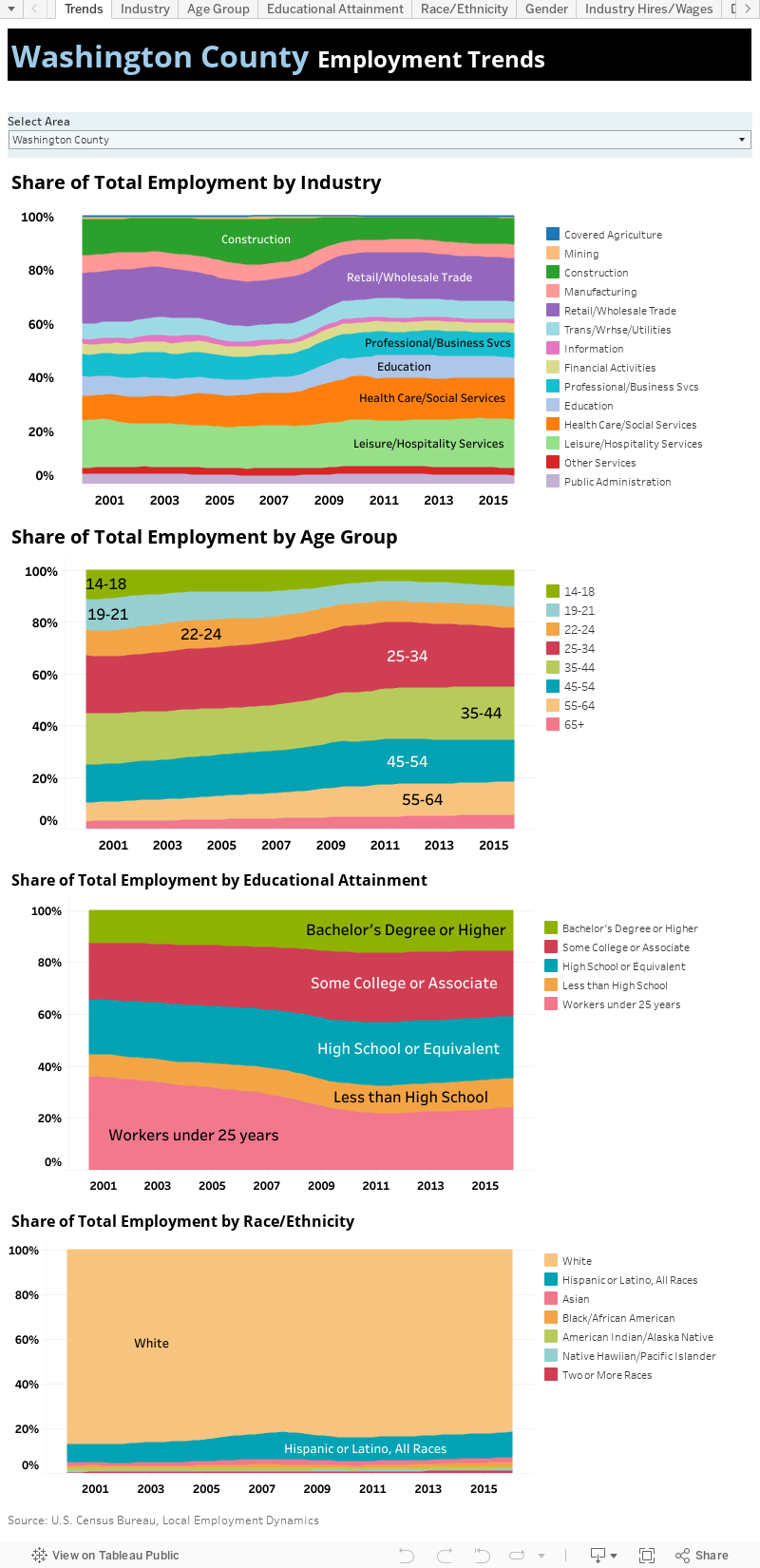
Yet each state’s profiling of individuals is quite minimal in the unemployment insurance program. The U.S. Census Bureau can bring more light to the overall labor force by supplementing said information with gender, age, race/ethnicity and educational attainment (imputted from American Community Survey responses) for Utah’s labor force.

The Census Bureau packages this information through their Local Employment Dynamics program and makes available said data on its website. Here at the Department of Workforce Services, we recently downloaded and packaged Utah-specific data from said website and summarized it in the attached visualization.


Tuesday, November 10, 2015

Either Side of the Mountain: Utah’s Two County “Tech-Highway”

By Cory Stahle, Regional Economist

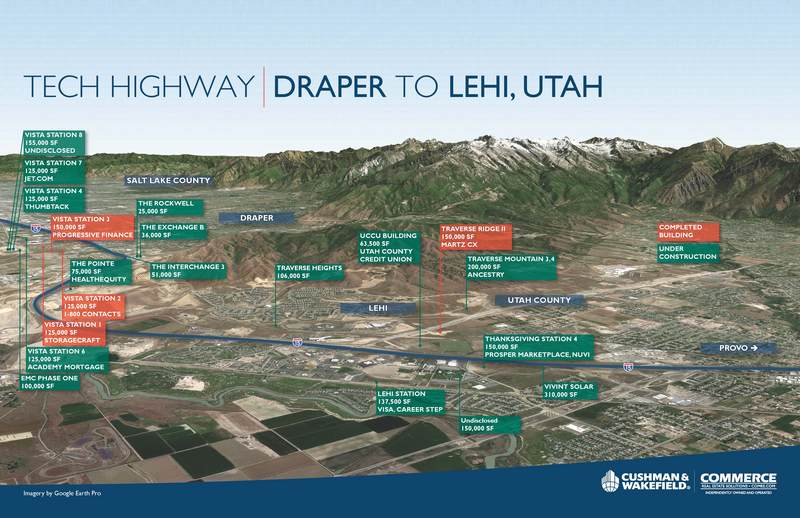
A recently released report from real estate firm Cushman & Wakefield | Commerce, describes a record breaking construction trend occurring around the border of Salt Lake and Utah counties. In the past decade, the entirety of Salt Lake County and northern Utah County (900 plus square miles) have averaged less than one million square feet of new office construction annually. Over the past nine months this annual average has been dwarfed by a five square-mile area along I-15 between Draper and Lehi. With nearly two million square feet of new commercial construction projects underway, primarily in behalf of technology companies, the area is being coined by some as Utah’s “Tech-Highway.” A visual of the growth in construction is illustrated in the following image:

Image Property of: Cushman & Wakefield | Commerce
Construction is a driver and manifestation of the economic growth occurring in the Salt Lake City and Provo metropolitan areas. With a combined job growth rate of 4.2 percent from June 2014 to June 2015, Utah and Salt Lake counties are seeing significant increases in the number of jobs available. A significant portion of these job gains, in line with the Cushman report findings, are occurring in professional/technical service occupations and in construction. In comparing June 2015 to the previous year, nearly 14 percent of total job gains in Utah and Salt Lake counties were in professional/technical fields. Similarly, construction accounted for 10.8 percent of jobs in the two counties during the same period.

Monday, August 3, 2015

Local Insights updated on the web

By Mark Knold, Supervising Economist 

Shelter is one of humanity’s basic needs. That is why housing is everywhere. Since housing is so ubiquitous, it becomes an important component in an economy’s foundation, and as such becomes an economic indicator.

In this issue of Local Insights, we look at the demand for housing structures, the amount of housing permits and their history, and how this history shows that housing demand follows the ups and downs of a region’s economic performance. In evaluating the volume of housing permits, we also parallel the health and vitality of the local economy.

People need jobs that supply them income in order to afford housing. Jobs are not the only factor, as things like affordability and the ability to obtain lending also play their part in housing demand. But the foundation of housing demand is the health of the job market.


The graph shows Utah statewide housing permits. A trend of normal permitting activity is evident from 1996 through 2004. Permits rose during the pre-Great Recession boom, then became lethargic for the seven years following. It is just recently that the volume of permit activity is again approaching something normal. That in itself is an economic indicator of an improved Utah economy.


--------------------------------------------

To read more, see the latest issues of Local Insights. To receive a printed copy, please call 801-526-9785.